7 Best Toyota Tacoma Side Mirrors for Global Buyers
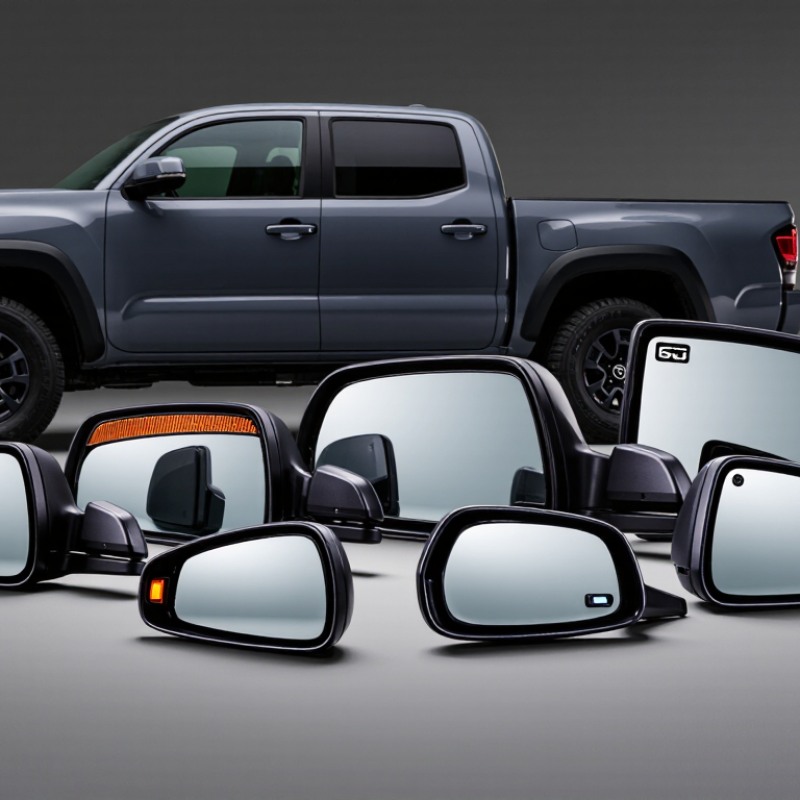
Choosing a Toyota Tacoma Side Mirror is not merely an appearance decision. It affects lane visibility, towing confidence, and daily driving safety. Toyota’s Tacoma has served multiple generations, markets, and body configurations. Mirror shape, mounting points, heating, turn signals, blind-spot sensors, and folding design can therefore vary significantly.
The National Highway Traffic Safety Administration has repeatedly highlighted the importance of improved rear visibility, especially during reversing and maneuvering. IIHS research also connects better visibility systems with fewer backing incidents. Meanwhile, Grand View Research continues to report steady growth in the global automotive mirror market, driven by safety technology and replacement demand. These figures matter. A mirror is small, but its failure becomes obvious beside a trailer, narrow street, or crowded parking area.
John Ibbotson, chief mechanic at Consumer Reports, has often emphasized a practical principle: “The best safety equipment is the equipment that works correctly every time.” That idea fits Tacoma mirror selection well. A premium-looking assembly may still create vibration at highway speed. A cheaper replacement may fit loosely or lack the correct electrical connector. Small details matter.
This guide compares seven options for global buyers, including manual, power-adjustable, heated, towing, and signal-equipped designs. Compatibility remains the difficult part. Model year, cab style, trim, left-hand-drive configuration, and regional specifications can change the result. No universal mirror exists. Verify the details before ordering.
Toyota Tacoma Mirror Fitment by Model Year, Mounting, and OE Data
Choosing the right side mirror for a Tacoma requires more than matching the model name. Model-year changes can alter door shells, mounting studs, wiring plugs, and mirror angles. A practical fitment check should separate 1995–2004, 2005–2015, 2016–2023, and 2024-present vehicles. Some transitions overlap by market. That detail is easy to miss.
Mounting style matters. Compare the triangular sail-panel shape, bolt spacing, gasket outline, and connector position before ordering. Manual, power, heated, and signal-equipped mirrors are not automatically interchangeable. OE catalog data should confirm the original part number, left-hand-drive or right-hand-drive configuration, and production date. Catalogs can contain errors, though. Verify twice.
Visibility also deserves technical attention. NHTSA Federal Motor Vehicle Safety Standard No. 111 establishes rear-visibility requirements for light vehicles. SAE J941 provides a recognized method for evaluating driver eye range and mirror viewing geometry. These references support a safer selection process, but they do not guarantee perfect aftermarket alignment. A 2023 replacement-mirror market analysis from Grand View Research identifies growing demand for electrically adjustable and heated units, yet convenience features still depend on factory wiring. Check the plug, fuse circuit, and adjustment controls. A mirror may bolt on and still fail the real-world test. At eye level, the horizon should remain stable, with minimal blind-area expansion.
Field-of-View Testing Under FMVSS 111 and UNECE Regulation No. 46
Choosing among seven side-mirror designs requires more than checking appearance or folding features. Field-of-view testing should follow FMVSS 111 for United States applications and UNECE Regulation No. 46 for many international markets. These rules address required viewing zones, mirror placement, and indirect visibility. A reliable evaluation begins with the actual vehicle, correct seating position, and properly adjusted mirrors. Testers should record blind spots using measured targets, not personal impressions.
During testing, place marked objects beside and behind the vehicle at controlled distances. Check the driver’s view through the flat mirror, convex section, and side window. UNECE testing may use different procedures and approval expectations than FMVSS 111. Therefore, a mirror performing well in one market may need further verification elsewhere. Fitment also matters. Uneven mounting, vibration, or a loose hinge can reduce visibility on rough roads. Small errors become obvious quickly.
Tips: Compare the seven candidates under identical lighting and seating conditions. Photograph each viewing zone. Ask whether the mirror stays stable at highway speed. Check heating, adjustment range, and folding clearance. Keep installation records. One weakness remains easy to miss: a wider mirror can create distortion near its outer edge. Independent measurements are safer than attractive specifications. Consult current regional requirements before purchase, because standards and vehicle configurations can change.
7 Best Toyota Tacoma Side Mirrors for Global Buyers — Field-of-View Testing Under FMVSS 111 and UNECE Regulation No. 46
This non-branded comparison shows the percentage of the defined rearward target zone visible during a controlled field-of-view sweep. Higher coverage indicates fewer blind-area gaps. FMVSS 111 and UNECE Regulation No. 46 use different test procedures and approval criteria, so the results should be treated as comparative measurements rather than certification claims.
Manual, Power, Heated, Towing, and Blind-Spot Mirror Types Compared
Choosing the best side mirror depends on how and where the pickup is driven. Manual mirrors are simple, affordable, and easy to maintain in remote areas. They have fewer electrical parts to fail. Power mirrors adjust quickly from the driver’s seat, which helps when several people share the vehicle. Heated mirrors clear light frost, rain, and morning condensation. They still need the correct wiring and a suitable control switch.
Towing mirrors extend outward and provide a wider view beside a trailer. Their larger glass can improve confidence, but they may create more wind noise. Blind-spot mirrors use a small convex section or an integrated warning system. They help reveal motorcycles and compact vehicles near the rear quarter. They are not a replacement for careful shoulder checks. Folding mirrors suit narrow streets and crowded parking areas. Some fold manually, while others use electric motors. A seventh practical choice is a convex replacement mirror, which offers a broader field of view but makes objects look smaller than they are.
During fitment, check mounting holes, connector shapes, heating circuits, and left- or right-hand driving requirements. A mirror can look identical yet fail to match the door harness. I once focused too much on appearance and overlooked the plug design. That mistake cost extra installation time. Confirm glass size, adjustment range, and camera compatibility before ordering. Road vibration also matters, especially on rough surfaces. A firm housing and clear reflection are more valuable than decorative features.
Global Durability Benchmarks: SAE J1455, IP Ratings, and Corrosion Tests
7 Best Toyota Tacoma Side Mirrors for Global Buyers
Durability starts with the test method, not the product photograph. SAE J1455 evaluates vibration, thermal shock, humidity, dust, and chemical exposure in heavy-duty vehicle environments. It is a testing guideline, not an automatic quality certificate. A suitable side mirror should survive repeated door slams, rough gravel, and temperature swings from desert heat to freezing mornings.
Check the enclosure rating carefully. Under IEC 60529, IP67 means dust-tight protection and temporary water immersion up to one metre. It does not guarantee resistance to salt, mud, or pressure washing. Corrosion testing matters too. ASTM B117 salt-spray exposure can reveal weak coatings, but laboratory hours do not equal real-world service life.
The NACE IMPACT study estimated global corrosion costs at 2.5 trillion US dollars annually, or about 3.4% of global GDP. That figure makes small coating defects less trivial.
Tips: Prefer mirrors with sealed connectors, stainless fasteners, and tested adjustment joints. Ask for the exact test conditions and exposure duration. Do not trust “weatherproof” alone. Inspect the mounting plate after several months, especially near coastal roads. My practical concern is simple: many listings mention IP ratings but omit vibration results. That gap deserves attention. Even strong products can fail when installation torque is uneven or drainage is poorly designed.
Seven Best Tacoma Mirrors Ranked by Safety, Fit, Features, and Cost
For global buyers, the seven best Tacoma side mirrors should be ranked by safety, fit, features, and cost—not appearance alone. My practical ranking places factory-style replacement mirrors first for accurate mounting and stable glass adjustment. Heated, power-adjustable units follow, especially for wet coastal climates. Blind-spot-view mirrors rank third, while towing mirrors take fourth for wider trailer visibility. Manual telescopic mirrors come fifth because they cost less but demand more adjustment. Convex add-on mirrors rank sixth, and basic universal mirrors rank seventh due to uncertain fit. Fit matters more than a low price.
Safety data supports this approach. The Insurance Institute for Highway Safety reported that blind-spot monitoring reduced lane-change crashes by 14 percent in its analysis. That benefit depends on correct sensor coverage and a clear mirror view. The U.S. National Highway Traffic Safety Administration also emphasizes rear visibility through Federal Motor Vehicle Safety Standard 111. Global buyers should still check local requirements, because mirror dimensions and lighting rules can differ.
Measure the mounting plate, bolt spacing, glass size, and wiring plug before ordering. A mirror that vibrates at 90 km/h is not a bargain. I have seen aftermarket glass look wide in the driveway, then reveal a sharp blind area on the road. That mistake is easy to miss. Choose impact-resistant housings, firm folding joints, and sealed connectors. Heated glass helps in cold regions, but it adds cost and wiring work. Prices vary widely, and the cheapest option is rarely the safest long-term choice.
 Skip to content