Skip to content

Top Barite Drywall Radiation Shielding Manufacturers

Radiation safety is becoming more demanding as diagnostic imaging, oncology, and industrial inspection expand. NCRP Report No. 160 estimated that medical exposure contributed about 3.0 mSv of the average annual US radiation dose of 6.2 mSv. That finding remains useful, although the report reflects older exposure patterns. It shows why dependable room shielding still matters.

Barite Drywall Radiation Shielding combines gypsum panels with high-density barium sulfate. The material can create a clean, practical barrier around X-ray rooms, dental suites, and imaging corridors. However, performance depends on panel density, joint design, wall thickness, installation quality, and the workload of each room. The IAEA Safety Standards emphasize that shielding should follow a qualified radiation protection assessment, not a product label alone.

Radiation protection expert Dr. Eric J. Hall described the field as “the science and art of protecting people and the environment from the harmful effects of ionizing radiation.” That principle guides this review of the Top Barite Drywall Radiation Shielding Manufacturers. The comparison considers manufacturing consistency, technical documentation, tested attenuation values, project experience, and support for local installation teams. A dense panel may look impressive on a specification sheet. Poorly sealed joints can still weaken the finished barrier. No ranking is perfect. Buyers should verify current test reports, independent certifications, material traceability, and engineering calculations before selection. These details help separate credible manufacturers from suppliers offering only attractive claims.
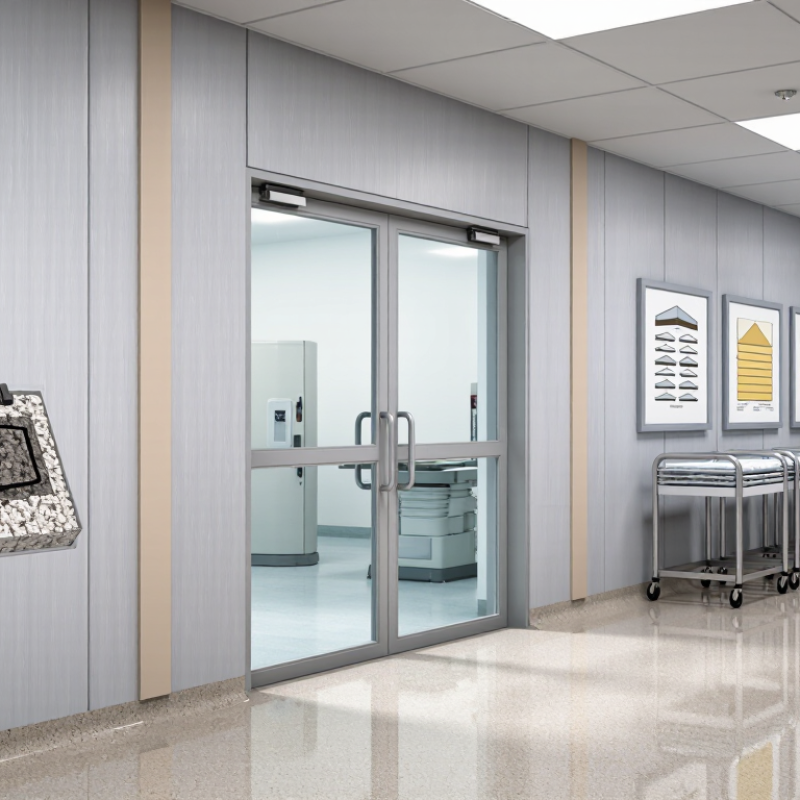
Top Barite Drywall Radiation Shielding Manufacturers

Definition and Purpose of Barite Drywall Radiation Shielding

Barite drywall radiation shielding is a gypsum panel containing barite, a dense mineral rich in barium sulfate. Its purpose is to reduce the passage of diagnostic X-rays through walls, ceilings, and doors. The material absorbs and weakens radiation as it travels through the panel. Think of it as a dense barrier, not an invisible force field. It does not block every radiation type or replace proper room design.

This drywall is commonly considered for X-ray rooms, dental imaging areas, CT suites, and medical laboratories. Its required thickness depends on equipment energy, workload, room location, and nearby occupancy. A qualified radiation physicist should calculate the shielding plan before installation. Local building and radiation-safety requirements also matter. Guesswork can create expensive corrections later.

Details get missed. Seams, corners, electrical boxes, pipes, and door frames can become weak points. Panels must be fitted closely, with joints treated according to the approved design. On-site inspections should check panel density, thickness, fastening, and openings before finishes cover the walls. Field measurements may also confirm whether the completed room performs as intended. Barite drywall can simplify construction, but it is not automatically safer than every alternative. A small installation error may reduce protection, and that practical risk deserves honest attention.

Key Properties and Performance Standards

Top Barite Drywall Radiation Shielding Manufacturers

Key Properties and Performance Standards

Reliable barite drywall begins with measured density, uniform filling, and stable panel thickness. Barite has a high mineral density, but the finished board performs differently from loose ore. Voids, edge gaps, and poorly sealed joints can reduce shielding continuity. Field installers should inspect cut edges, fasteners, penetrations, and service openings. Small gaps matter.

NCRP Report No. 147 explains that diagnostic X-ray barrier design depends on workload, tube voltage, distance, and occupancy. It does not support one universal panel thickness. IAEA Safety Reports Series No. 47 also recommends calculating shielding from room use and radiation direction. Manufacturers should provide attenuation results from independent laboratories, including test energy, exposure geometry, and areal density. A lead-equivalence value without test conditions is incomplete. Too often, product sheets hide this detail.

Material verification should include density testing, dimensional checks, moisture resistance, and joint performance. ASTM C1396 provides relevant requirements for gypsum panels, while ASTM C472 covers physical testing methods for gypsum and plaster materials. Fire performance may require separate evaluation under ASTM E119 or applicable local standards. These standards do not automatically prove radiation protection. The difficult part is connecting laboratory data with real installation conditions. A panel may pass a controlled test yet underperform when joints are uneven. Reliable manufacturers therefore document batch testing, calibration records, and installation tolerances. Some specifications still need clearer evidence.

How Barite Drywall Shielding Is Manufactured

Barite drywall shielding begins with material selection, not panel pressing. Barite is valued for its high specific gravity, typically about 4.2–4.5, according to the U.S. Geological Survey’s Mineral Commodity Summaries. Manufacturers crush and grade the mineral before blending it with gypsum, water, and controlled additives. The mixture must remain workable while retaining enough density for radiation attenuation.

The wet compound is formed into boards under controlled pressure. It is then dried, trimmed, and tested for thickness, mass, moisture, and dimensional stability. Production teams often inspect edges closely, because a small void can weaken a joint. Some panels use reinforced facing to improve handling. Others require customized dimensions for imaging rooms. These choices affect installation speed and shielding continuity.

NCRP Report No. 147 explains that shielding design depends on workload, use, occupancy, and distance, rather than one universal wall thickness. IAEA Safety Reports Series No. 47 also emphasizes project-specific calculations and verification. Therefore, manufacturers should provide batch density records and test documentation, not only attractive product claims. A practical weakness remains: laboratory uniformity may not match a busy construction site. Poorly fitted seams, penetrations, or unsealed outlets can reduce real-world performance. The board is only one part of the protective system.

Top Barite Drywall Radiation Shielding Manufacturers - How Barite Drywall Shielding Is Manufactured

Manufacturing or Product Dimension Typical Industry Data Why It Matters for Radiation Shielding Quality-Control or Verification Method
Primary shielding material Processed barite, a naturally occurring barium sulfate mineral, is blended into a gypsum- or cement-based matrix. Barite increases the material’s mass attenuation and bulk density compared with ordinary gypsum board. Mineral identification, chemical analysis, particle-size testing, and incoming-material inspection.
Barite mineral density The specific gravity of pure barite is commonly about 4.0–4.5. Higher-density aggregate generally permits greater attenuation per unit thickness, although final performance depends on composition and geometry. Specific-gravity measurement and laboratory density testing of the processed mineral.
Aggregate preparation Barite is typically crushed, dried, screened, and milled or graded before mixing. Consistent particle grading supports uniform density and reduces voids that can create weak shielding areas. Moisture content, sieve analysis, particle-size distribution, and visual checks for contamination.
Binder system Common systems include gypsum-based binders or cementitious binders combined with water and performance additives. The binder holds the heavy aggregate in a stable panel and affects strength, curing, fire behavior, and dimensional stability. Binder proportion control, setting-time testing, compressive or flexural-strength testing, and moisture checks.
Mixing process Dry ingredients are proportioned by mass and mechanically blended before water or other liquid components are added. Accurate batching helps maintain consistent areal density and prevents localized variations in shielding performance. Batch records, calibrated scales, mixing-time control, and sampling from different points in the mix.
Panel forming The wet or semi-wet compound is formed into sheets using molds, boards, continuous forming equipment, or compression methods. Controlled forming produces a consistent thickness and minimizes internal voids and edge defects. Thickness gauges, surface inspection, dimensional checks, and cross-sectional examination.
Common panel thicknesses Commercial shielding boards are commonly produced in thicknesses such as approximately 12.5 mm, 15.9 mm, and 19 mm; availability varies by product design. Increasing thickness generally increases attenuation, but the required thickness must be calculated for the radiation energy, workload, distance, and occupancy. Nominal-versus-actual thickness measurement at multiple locations on each panel.
Typical panel dimensions Panels may be manufactured in standard drywall-style sheet formats, with project-specific dimensions available from some producers. Sheet size affects the number of joints, installation time, and the risk of discontinuities in the shield. Length, width, squareness, edge straightness, and corner-condition inspection.
Bulk density Barite-containing shielding panels are substantially heavier than conventional gypsum wallboard; actual density is product-specific and should be taken from certified test data. Bulk density is a key input when comparing shielding effectiveness, structural loading, and handling requirements. Oven-dry or conditioned mass divided by measured volume, using a documented test procedure.
Curing and drying Panels are cured and, where necessary, dried under controlled temperature, humidity, and airflow conditions. Proper curing reduces cracking, shrinkage, warping, and moisture-related changes that could affect installation quality. Moisture content, dimensional stability, surface hardness, and visual crack inspection.
Reinforcement or facing Depending on the design, panels may use paper facings, glass-fiber reinforcement, mesh, or other surface treatments. Facing and reinforcement improve handling, edge integrity, surface durability, and resistance to cracking. Bond-strength testing, edge-impact checks, delamination inspection, and surface-quality review.
Cutting and edge finishing Sheets may be trimmed, cut to size, beveled, or supplied with square edges according to the installation system. Well-finished edges help maintain tight joints and reduce gaps that may require additional shielding treatment. Dimensional tolerance checks, edge inspection, and verification of cut-surface integrity.
Radiation-shielding performance Performance is commonly reported using transmission measurements or calculated attenuation for a defined X-ray or gamma-ray spectrum. No single shielding value applies to every installation; energy, beam direction, workload, distance, and occupancy must be considered. Project-specific shielding calculations and, when required, independent transmission testing.
Joint and penetration treatment Shielding systems may use staggered joints, overlapping layers, compatible heavy joint compounds, and sealed service penetrations. Gaps, unsealed joints, doors, windows, ducts, and electrical penetrations can become radiation leakage paths. Installation drawings, joint-layout reviews, photographic inspection, and field radiation surveys where specified.
Structural and handling considerations The high mass of barite panels requires suitable framing, fasteners, lifting methods, and substrate capacity. Insufficient structural support can cause panel movement, cracking, or failure of joints and fixings. Load calculations, fastener pull-out testing, installation method statements, and site acceptance checks.
Relevant technical references Gypsum board properties may be evaluated against applicable gypsum-board standards, while shielding design is normally based on recognized radiation-protection guidance and local regulations. Standards provide a framework for material quality and testing, but they do not replace a project-specific shielding design. Review of product technical data, test reports, safety documentation, and approval requirements for the project location.

Note: Values shown as typical ranges or practices are general industry information. Final panel specifications, shielding calculations, structural requirements, and compliance documentation should be verified against the selected product and the applicable project regulations.

Leading Manufacturer Selection Criteria

Selecting a barite drywall radiation shielding manufacturer requires evidence beyond a dense product sample. NCRP Report No. 147 bases shielding design on workload, use factor, occupancy, and distance. A responsible manufacturer should calculate these inputs with qualified radiation physicists. It should also provide attenuation data across the project’s actual X-ray energy range. One number is not enough.

Independent testing deserves careful attention. IAEA General Safety Requirements Part 3 references a 20 mSv annual occupational dose limit, averaged over five years, and 1 mSv annually for the public. These limits do not replace local rules, but they show why predictable performance matters. Ask for laboratory reports, panel thickness, dry density, joint details, moisture controls, and batch traceability. Factory quality systems help. ISO 9001 certification alone does not prove shielding effectiveness.

Installation experience is equally important. Panels should arrive with clear cutting limits, compatible fasteners, sealed penetrations, and practical repair guidance. A manufacturer that audits completed rooms can reveal recurring failures, especially around doors, corners, sockets, and ventilation openings. Look for measured site surveys, not only computer models. Dense material can still underperform when joints are poorly sealed. I would also question unusually precise claims without test conditions. That doubt is useful. It pushes selection toward transparent data, qualified support, and documented corrective action.

Top Barite Drywall Radiation Shielding Manufacturers — Leading Manufacturer Selection Criteria

This practical 100-point procurement model prioritizes shielding performance, verified testing, product consistency, fire and safety compliance, installation support, delivery reliability, and total project cost. Buyers can adjust the weighting to match project-specific radiation protection requirements.

Applications, Installation, and Safety Considerations

Top Barite Drywall Radiation Shielding Manufacturers

Applications, Installation, and Safety Considerations

Barite drywall is used in diagnostic X-ray rooms, dental suites, veterinary clinics, and imaging laboratories. Its high-density core helps reduce scattered radiation through walls, ceilings, and doors. Reliable manufacturers provide consistent density, clear thickness data, and independent test documentation. These details matter more than attractive packaging. A qualified medical physicist should review the room layout before materials are ordered. Shielding needs depend on workload, equipment voltage, distance, and adjacent occupancy.

Installation requires careful planning around joints, corners, outlets, pipes, and ventilation openings. Crews should stagger board seams and avoid direct pathways through the shield. Fasteners must suit the supporting structure without creating weak points. Cut edges need proper treatment, especially around service penetrations. Heavy panels may require reinforced framing and mechanical lifting. I have seen rushed installations leave small gaps behind electrical boxes. They looked harmless. They were not.

Safety begins with a documented shielding design and continues through construction. Workers should follow the product safety sheet, control dust, wear suitable eye and respiratory protection, and use safe lifting methods. After installation, a qualified professional should inspect the work and conduct radiation surveys with calibrated instruments. Keep records of material batches, thicknesses, photographs, and test results. Regulations vary by location, so local authorities must be consulted. One practical weakness remains: field conditions can differ from drawings. Rechecking the finished room is essential.