Skip to content
What Is a Power Distribution Strip and How Does It Work?
A Power Distribution Strip is a compact device that delivers electricity from one wall receptacle to several connected loads. It usually contains an input cord, internal conductors, multiple outlets, and sometimes a circuit breaker or surge-protection module. Under normal conditions, current enters through the plug and travels across an internal bus to each outlet. The connected equipment then shares the strip’s rated capacity.
The distinction matters. A basic strip only expands access. A protected model may limit transient voltage, while a rack-mounted power distribution unit can monitor current and support organized equipment connections. UL Standard 1363 addresses relocatable power taps in the United States, while IEC 60884-1 provides relevant requirements for household plugs and socket-outlets. These standards do not make every product equally suitable. Labels, certification marks, cord ratings, and installation conditions still require careful inspection.
Professional safety evidence supports this caution. The National Fire Protection Association’s Electrical Fires report links many electrical incidents with overloaded equipment, damaged wiring, and improper use. Uptime Institute’s Global Data Center Survey also continues to identify power problems as a major source of service disruption. The lesson is practical: do not judge capacity by outlet count. A warm plug, buzzing sound, loose socket, or melted plastic needs immediate attention. Small details matter.
This guide explains how a Power Distribution Strip works, what its protection features actually do, and how to select one responsibly. A strip cannot repair faulty wiring. That limitation is easy to overlook. Even a certified product needs correct loading, ventilation, and routine inspection. Mistakes remain possible, especially when several high-wattage appliances share one connection.
Definition and Core Purpose of a Power Distribution Strip
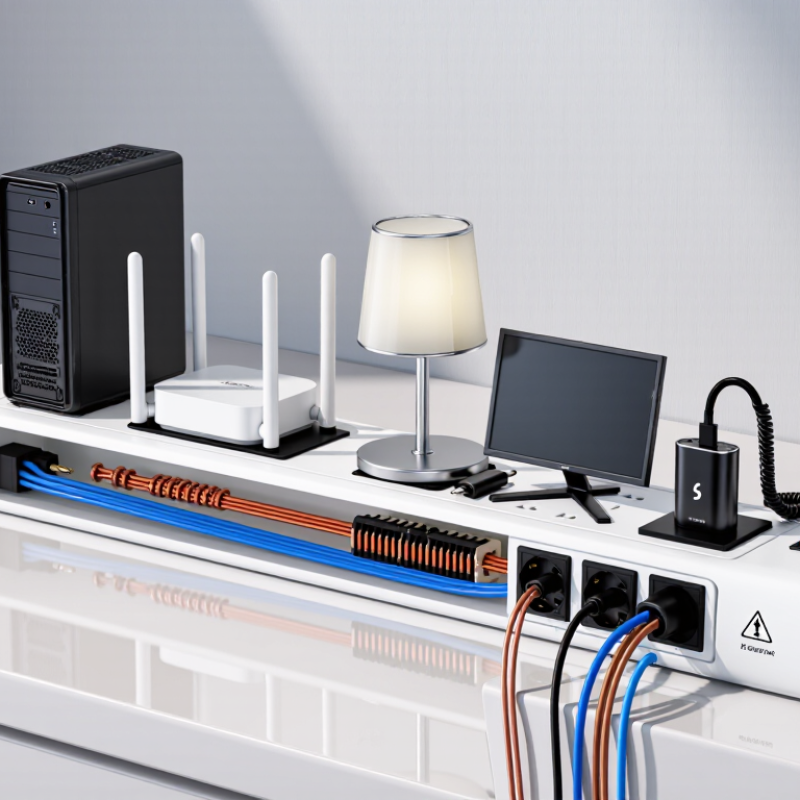
A power distribution strip is a compact device that divides one electrical supply into several usable outlets. Its core purpose is simple: distribute power safely and conveniently. A typical strip includes a flexible cord, outlet sockets, an on/off switch, and sometimes an internal fuse or circuit breaker. Some models add surge protection, but that feature is not automatic. A basic strip only provides more connection points.
The strip does not create extra electricity. Its total load remains limited by the wall outlet, cord, and internal components. For example, a 1,800-watt rating at 120 volts allows roughly 15 amps, but continuous use should leave a safety margin. The U.S. Department of Energy reports that standby power can represent 5% to 10% of residential electricity use. Switching off connected equipment can therefore reduce unnecessary consumption, though savings vary by device and usage.
A practical inspection should check the rating label, cable condition, and plug temperature. Warmth is a warning sign. The National Fire Protection Association reports that electrical distribution and lighting equipment contribute to thousands of home fires annually in the United States. That figure covers broader equipment categories, not power strips alone. Still, it shows why overload protection matters. The label is not always enough; damaged sockets or tightly coiled cables can change real-world performance.
What Is a Power Distribution Strip and How Does It Work? — Definition and Core Purpose of a Power Distribution Strip
| Data Dimension | Definition or Typical Data | How It Works or Why It Matters | Practical Consideration |
|---|---|---|---|
| Basic Definition | A power distribution strip is a device that distributes electricity from one power source to multiple connected loads. | It provides several outlets connected to a common incoming power cord and internal conductors. | It increases the number of available connection points but does not create additional electrical capacity. |
| Core Purpose | Centralized connection and orderly distribution of electrical power. | Multiple devices can be powered from one wall receptacle or facility power outlet. | The combined load must remain within the strip's rated current and power limits. |
| Main Electrical Path | Input plug → power cord → switch or protection device → internal bus conductors → output receptacles. | Electric current travels through the input cord and is routed in parallel to the individual outlets. | A parallel arrangement allows connected devices to receive the supply voltage independently. |
| Typical Input Voltage | Approximately 100–120 V AC or 220–240 V AC, depending on the electrical system. | The strip passes through the voltage supplied by the building circuit; it normally does not transform voltage. | The strip's voltage rating must match the local electrical system and connected equipment. |
| Common Current Ratings | Typical household and office models are commonly rated around 10–16 A. | The current rating indicates the maximum continuous current the strip is designed to carry. | The lowest rating among the strip, plug, circuit, and connected equipment should govern safe use. |
| Maximum Power | Calculated approximately as: Power (W) = Voltage (V) × Current (A). | For example, a 120 V, 15 A circuit has a theoretical limit of 1,800 W before applying safety margins. | Motor-driven and heating appliances may require additional capacity because of startup or continuous loads. |
| Outlet Configuration | Multiple AC receptacles, often arranged in a row or spaced layout. | Spaced outlets can accommodate bulky adapters without blocking neighboring connections. | The number of outlets does not indicate the amount of power available. |
| Grounding | A grounded strip includes a protective earth connection through the plug and receptacles. | Grounding provides a low-resistance path for fault current and helps protective devices operate. | Grounded equipment should be connected only to a properly grounded electrical receptacle. |
| Overload Protection | A resettable circuit breaker or thermal protection device may interrupt excessive current. | The protective device opens the circuit when current or temperature rises beyond a safe threshold. | Protection reduces risk but does not make an overloaded strip suitable for continuous overloading. |
| Surge Protection | Some strips include components that limit short-duration voltage surges. | Surge-limiting components divert or absorb part of a transient overvoltage event. | Surge protection has a finite service life and is not the same as voltage regulation or backup power. |
| Power Switch | A single-pole switch may control power to all outlets simultaneously. | Turning the switch off disconnects connected loads from the energized output path. | The switch is not always a substitute for unplugging equipment during maintenance or severe electrical events. |
| Indicator Light | A small indicator may show that the strip is receiving power or that protection is active. | The indicator provides a visual status reference for the input or protective circuit. | An illuminated indicator does not confirm that every connected device is operating correctly. |
| Cord Length | Common cord lengths range from about 1 to 5 meters, depending on the application. | A longer cord allows more flexible placement between the wall outlet and equipment. | The cord should be fully uncoiled during high-load operation to reduce heat buildup. |
| Typical Applications | Computers, displays, networking equipment, audio-visual devices, chargers, and workshop tools. | The strip consolidates power connections and can simplify equipment layout and shutdown. | High-power heating appliances and large motors may require dedicated wall outlets or circuits. |
| Not a Voltage Transformer | A standard distribution strip normally passes the supply voltage through unchanged. | It distributes power but does not convert 120 V to 230 V, or vice versa. | Equipment requiring a different voltage needs an appropriately rated transformer or power converter. |
| Not a Battery Backup | A basic power distribution strip stores no electrical energy. | Connected devices lose power when the upstream electrical supply fails. | Uninterruptible operation requires a separate backup power system with battery storage. |
| Safe-Use Principle | Keep the total connected load below the strip's rated current and power limits. | Limiting the load helps prevent overheating, nuisance trips, insulation damage, and fire hazards. | Do not connect one distribution strip into another when doing so could overload the upstream circuit. |
Our
Brands